
Westport Golf Links: Nowhere Near Approved
Despite what's been said publicly, the Westport Golf Links project still has a long way to go. On July 8, Washington State Parks Commissioners held a work session, during which Stewardship Director Lisa Lantz gave an update on the project. Joining her were Assistant Attorney General Joe Panesko and the Department of Ecology's Maria Sandercock and Zach Meyer. The presentation laid out how much of the proposal sits in tension with State Parks' own mission to preserve land and protect wetlands.
Westport Light State Park sign
Westport Golf Links wants to build a Scottish links-style golf course, hotel, golf range, and associated amenities on land within Westport Light State Park, a 560-acre park in the City of Westport. Because the proposal was determined to have significant adverse environmental impacts, the State Environmental Policy Act required an Environmental Impact Statement. Lantz told commissioners: "Over the last 25 years that I've been working in stewardship, this is the fourth, only the fourth EIS that I have been involved in, because typically the agency does not proceed with projects that require an EIS.”
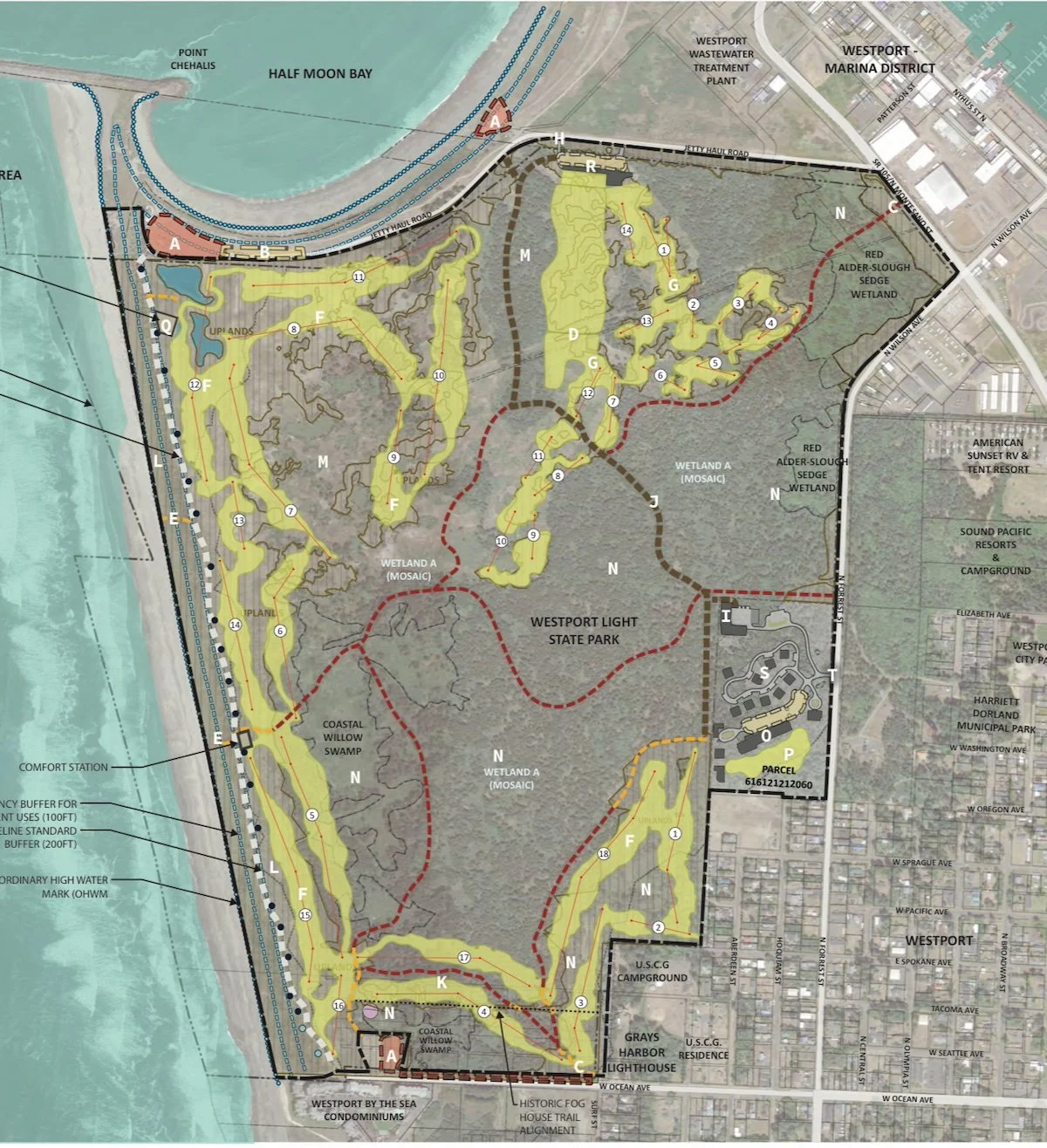
An image of the proposed Westport Golf Links golf fairways (in light green).
The Wetlands
A 2021 wetland delineation of the park found a single, continuous wetland mosaic covering the bulk of the property, plus adjacent coastal willow swamp and red alder-slough sedge forest. Altogether, wetlands, wetland-adjacent habitat, and wetland buffers cover roughly 93% of the park. These aren't ordinary wetlands. They're classified as interdunal wetlands, systems that form between coastal dunes, and Westport Light holds the second-largest expanse of interdunal wetlands in the state of Washington. Most of that acreage is rated Category 1, the highest protection tier under state wetland rules, reserved for wetlands that are rare, largely undisturbed, or provide exceptional ecological functions.
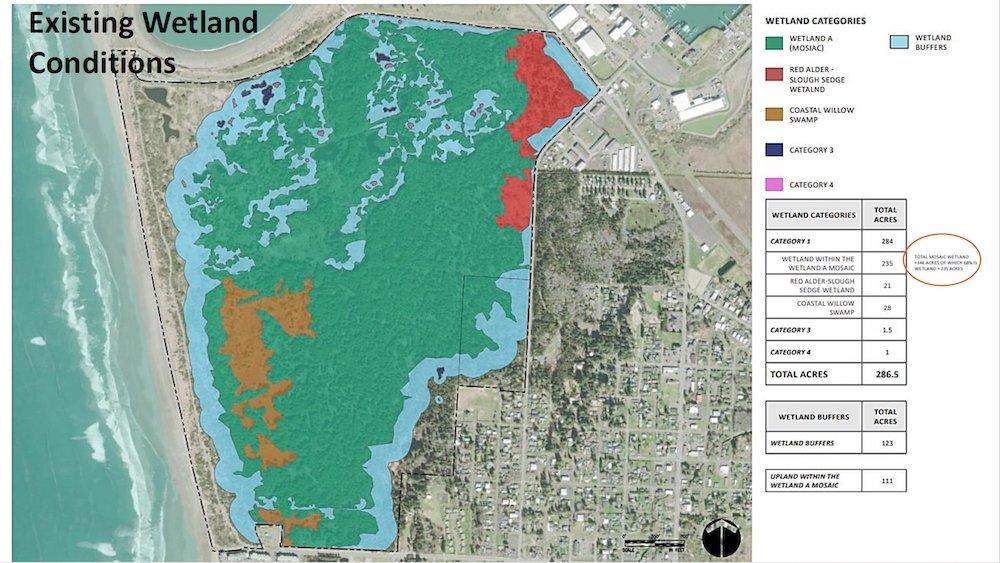
An image of the wetland mosaic in Westport Light State Park. Wetlands make up 286 acres and 123 acres of wetland buffers.
Westport Golf Links presented two designs in the Draft Environmental Impact Statement that would directly fill, clear, or impact 35 to 43 acres of those wetlands, plus 118 to 128 acres of wetland buffers. In the July 8 presentation, the Department of Ecology told commissioners that “this would be the largest wetland-impact project the agency has ever been asked to permit.”
Lisa Lantz shared that Westport Light is not zoned for a golf course under the current proposal. The park operates under a Comprehensive Area Management Plan, or CAMP, last revised in 2016. Lantz showed that the only piece of the park currently classified as a "recreation area" (for high-intensity use) is the 34 acres shown outlined in red. (see below) Before any of it could move forward, the Commission would need to reclassify a significant part of the park, reopening a planning decision that's less than ten years old and requires a lengthy public process.
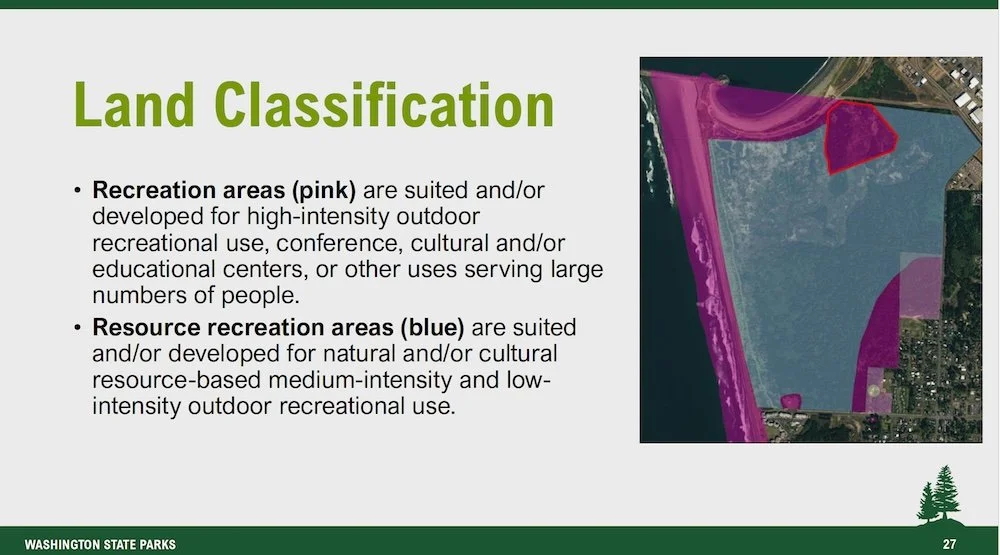
In 2016, a comprehensive Area Management Plan classified only a small portion of the Westport Light Park for high intensity recreation
What the Rules Require
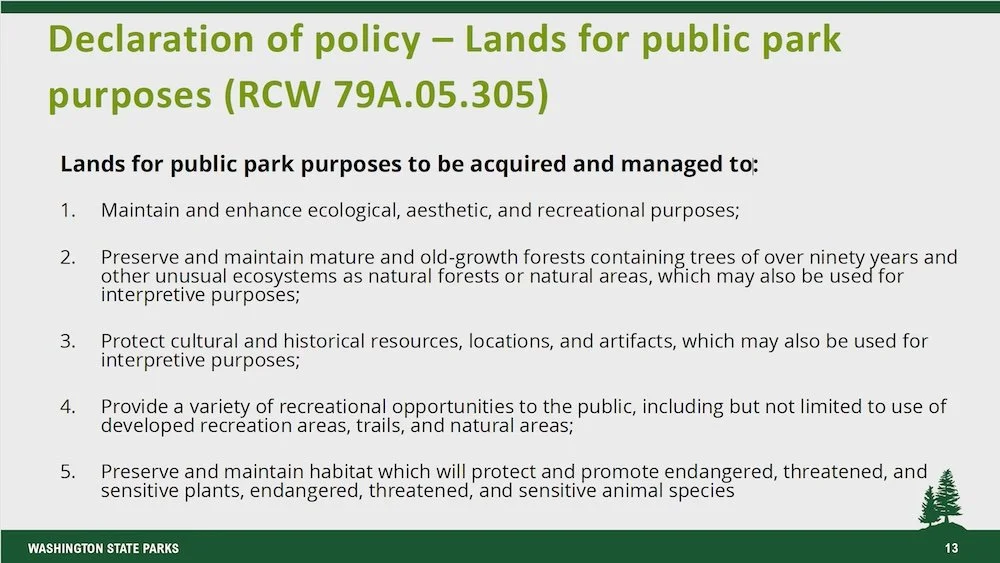
Washington State Parks is bound by its own statutes and policies, and Lisa Lantz walked commissioners through them point by point:
State law (RCW 79A.05.305) directs that parkland be acquired and managed to preserve habitat for threatened and sensitive species, protect natural ecosystems, and maintain ecological value alongside recreation. As Lantz told commissioners, the statute doesn't rank these interests against each other: "There is no statutory hierarchy that guides decision-making."
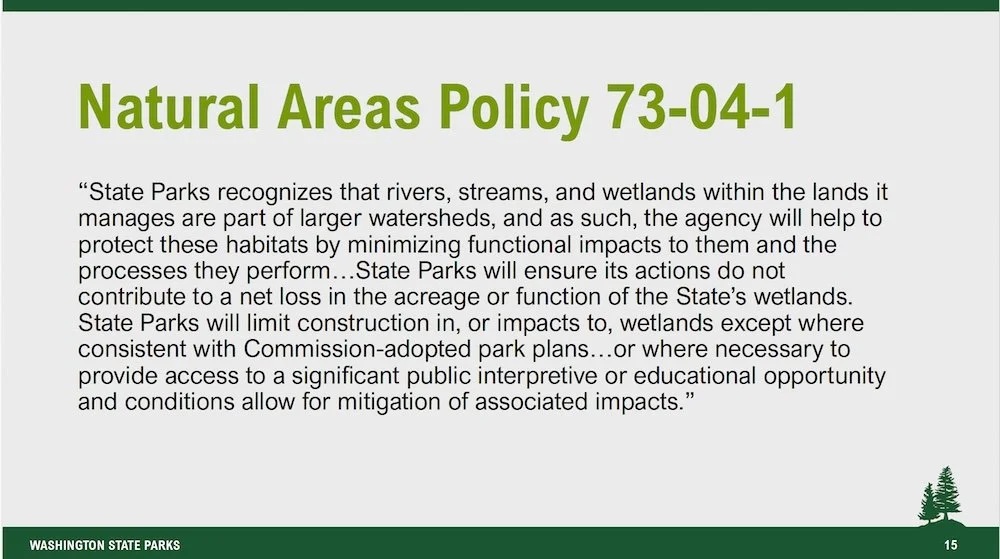
The agency's Natural Areas Policy commits State Parks to ensuring that its actions "do not contribute to a net loss in the acreage or function of the State's wetlands," and limits construction in wetlands except where it's consistent with an already adopted park plan.
The Critical Areas Policy goes further: new development isn't allowed in critical areas like wetlands unless there's "overriding justification," meaning no feasible alternative exists, impacts can be mitigated, and a favorable cost-benefit ratio is shown. The draft EIS argues Westport Light was the only West Coast site that fit the developer's requirements for a Scottish-links-style course. Commissioners have not yet decided whether that meets the legal bar.
The 2015 Climate Change Resolution requires all agency decisions to be evaluated for climate vulnerability. A 2022 coastal erosion study modeled decades of shoreline retreat combined with a 30-year storm event and found that portions of the proposed golf holes would be at risk of coastal erosion within just 25 years.
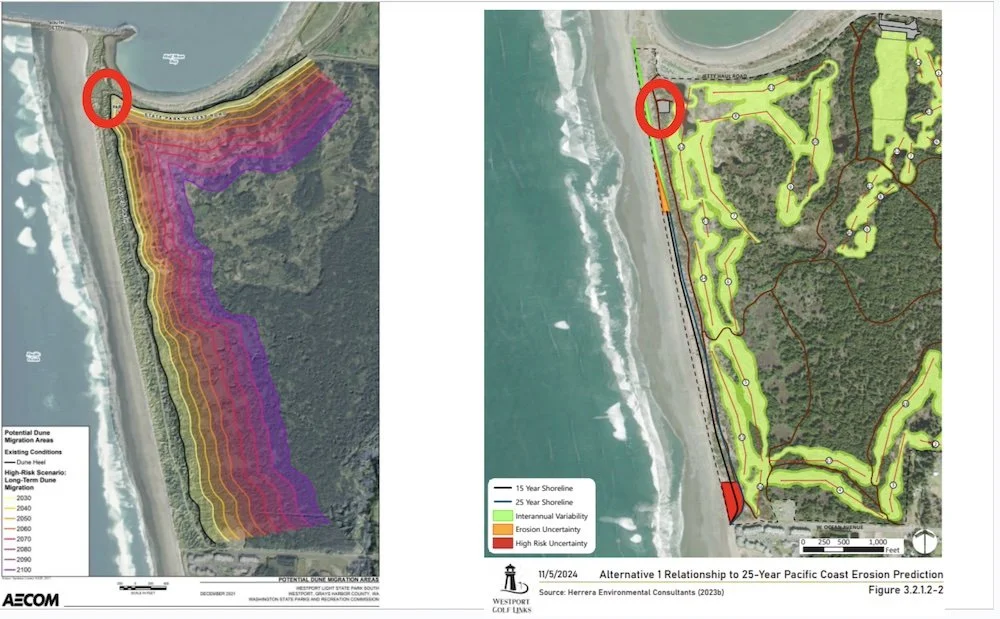
An image of 25 year projected coastal erosion. Link to full report.
State Parks' own policies set a high bar for this kind of development. The Westport Golf Links proposal, as currently designed, raises real questions against nearly every one of them. As Stewardship Director, Lantz's presentation gave commissioners what they needed to weigh those questions for themselves.
Lingering Legal Timeline
After Lantz’s presentation, Assistant Attorney General Joe Panesko spoke to commissioners about legal timelines and what happens if this project clears permitting and gets appealed. He pointed out many discrepancies between the timeline Westport Golf Links provided to the commission and the reality of a lawsuit currently filed by Friends of Grays Harbor. Panesko said, “So just the current lawsuit alone, we're more than two years in with no end in sight.” He then explained that Shoreline Hearings Board cases are supposed to be resolved within 180 days, but they routinely take longer for complex matters. From there, appeals can move through Superior Court (which could take one to three years) and the Court of Appeals, with possible additional review by the state Supreme Court. He also referenced the previous attempt to build a golf course in the park that took close to seven years of permitting and appeals before ending in a 2007 settlement.
Written comments on the draft EIS from the Department of Ecology were also raised, stating that the current proposal doesn't work. The department's comment letter states: "As presented in the Westport Golf Links proposal for Westport Light State Park draft environmental impact statement dated April 2025, alternatives one and two would not meet the necessary permit requirements. Ecology would be unable to approve permits or administrative orders to construct this project under RCW 90.48, Water Pollution Control Act, or to authorize a shoreline variance under the Westport SMP."
But at the work session, Ecology staff were careful to note this isn't a final rejection. They said there has been no formal permit application before them yet, so they're identifying gaps at a conceptual level. Still, the gaps they described are substantial: proposed mitigation that leans on preserving existing park wetlands, which State Parks' own policy generally doesn't allow, since parkland wetlands aren't supposed to be under threat in the first place, and mitigation sited on land outside State Parks' ownership. Meaning the park absorbs the wetland loss without receiving the corresponding benefit of the mitigation project.
Whats Next
The Final EIS is still in preparation, with no release date set as of the July meeting. Even after it's issued, the commission has been clear that it intends to review it and hold a separate discussion before deciding whether to move forward at all. Commissioners have expressed open frustration with the developer's shifting timelines, and several suggested Parks should be actively exploring what else this park could be.
This was also Lisa Lantz's last presentation before retiring, closing out 25 years in the agency's stewardship program.
This article is based on Washington State Parks and Recreation Commission meeting materials, staff presentations, and some images are from the slideshow.
A link to the July 8 workshop agenda.
A link to the Westport Light PowerPoint.
A link to the meeting recap.
A link to a video recording of the meeting.